What Is an EV DC Fast Charger, and When Does It Make Sense at Home?
Most EV owners do not think about fast charging until the calendar gets messy. A car comes home low, another trip starts in two hours, and the usual overnight routine is not enough. That is when DC fast charging begins to sound less like a highway feature and more like a home-energy question.
The International Energy Agency’s Global EV Outlook 2026 says electric car sales exceeded 20 million in 2025. As EVs become normal household loads, the charger is no longer just an accessory. It can become part of the way a home uses solar, storage, and backup power.
AC Charging Fills Slowly; DC Charging Bypasses a Step
Most home chargers are AC chargers. They send alternating current to the vehicle, and the car’s onboard charger converts it to DC for the battery. A DC fast charger performs that conversion outside the vehicle and sends direct current to the battery more directly.
The U.S. Department of Energy’s Alternative Fuels Data Center explains that Level 2 charging commonly uses 208-volt or 240-volt power, while DC fast charging is the higher-power option used for rapid charging. That does not make DC automatically better at home. It simply means it solves a different problem.
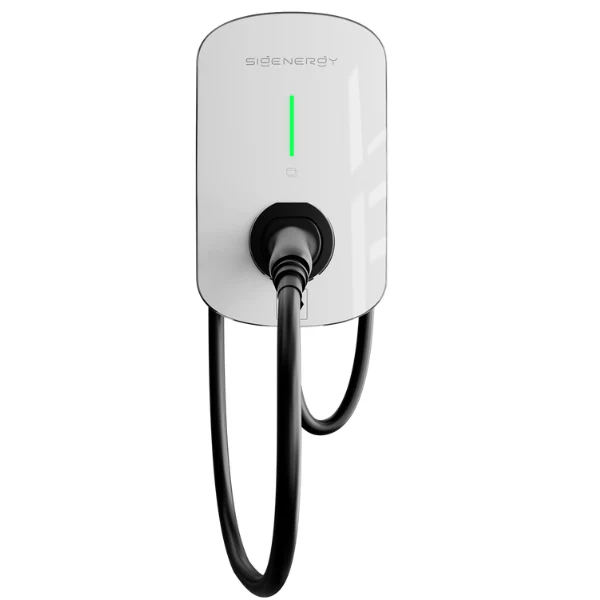
For a household comparing basic wall boxes with broader charging options, Sigenergy Smart EV Chargers show how EV charging can sit inside a larger home energy setup rather than operate as a standalone plug.
The Real Question Is Parking Time
If the car sits in the garage from dinner to breakfast, Level 2 charging is often enough. If the car comes and goes all day, faster charging may matter. The same is true for households with two EVs, shared charging windows, or frequent afternoon departures.
Solar timing can also change the decision. Rooftop solar often peaks while people are away. If the EV is home only briefly during strong solar production, a faster and smarter charging path may help use more on-site energy.
Bidirectional charging adds another layer. V2H, or vehicle-to-home, lets a compatible EV supply energy back to the house during an outage. V2G, or vehicle-to-grid, can export energy to the grid where utility rules allow it. According to Sigenergy product information, Sigen EVDC/V2X supports 25 kW bidirectional DC charging for V2H, V2G, and V2X applications.
When It Makes Sense
DC charging at home is worth studying when the charger is part of a system. That may include solar, stationary batteries, backup circuits, time-of-use rates, and app-based monitoring. Time-of-use rates are utility plans where electricity prices change by hour, so charging can be scheduled for lower-cost periods.
The wrong way to shop is to chase the biggest charging number. The better approach is to ask what the home needs: faster turnaround, solar self-consumption, backup power, or all three.
For many homes, Level 2 remains the practical first step. For homes planning around EV batteries, rooftop solar, and resilience, DC fast charging becomes a serious part of the conversation.
The key is coordination. A charger can only deliver what the vehicle, service panel, and utility connection can support. Good home design treats fast charging as one managed load among many, not as a separate appliance competing with the rest of the house.